


This studio in our portfolio is special. It was clear from the very beginning that there was an opportunity to create something unique.
 Of course, studios are always created within certain limits. But if we ignore the minor architectural and design restrictions inherent in any project, then in everything else I was free: in design, in the use of the latest technologies, in choosing a team, in innovation, design and much more. I also wanted to reconsider some existing stereotypes.
 The future studio was located on Podol in Kyiv, on the third floor of a new monolithic frame house. The building’s design gave us flexibility in the interior layout. The total area of the complex, including office space and reception, was approximately 140 sq.m., and the ceiling height was 340 cm. The room had access to a large terrace overlooking Kyiv Vozdvizhenka. There was also a separate exit to the balcony from the control room. The rooms had huge windows 3 meters high, almost from the floor.
 What we planned to build can hardly be called just a studio. Most likely, it should have been some kind of creative laboratory and, possibly, a production agency.
 The studio was supposed to specialize in modern – mainly electronic – music. This means that the control room must be spacious, and the monitor system must be capable of reproducing the lowest frequencies of sub-bass parts. The acoustic treatment of the room and its geometry had to provide acoustic control down to these frequencies.
 In addition to the control room, a vocal room was also planned. This was enough to solve creative problems. In addition, it was necessary to provide for the possibility of uncompromising vocal recording directly in the control room.
 Thus, we agreed that out of the total area of the room, about 50 sq.m. were allocated to the control room, and about 15 sq.m. to the vocal room. It was also necessary to preserve the existing windows as much as possible.
 Before the design began, we decided on monitors. The customer already had Focal Trio 11 near/mid-field monitors. And the far-field system was a selected stereo pair of Reflexion Arts 239X monitors. The design and configuration of this system took place simultaneously with the construction of the front wall.

A month and a half later, the project was ready.
 First of all, it was necessary to think about sound insulation, because this was a residential building. For this purpose, “floating” partitions were used and, with the permission of the civil engineers, a multi-layer “floating” floor weighing about 8 tons and about 18 cm thick.
 During the construction of the acoustic shell, specific parts were required using a CNC machine. This is how we met Alexander Kozachenko, who was not only an operator of such a machine, but also an interior designer. Together with our designer Maria Isaenko, they offered very interesting creative ideas.
 The front wall contained 15 layers of different materials, and its front part was composed of numbered plywood blanks. The main monitor system was part of this wall, and the bezels were painted in its color. The large studio window did not look out into the vocal room, as is often the case, but outward, with a view of Vozdvizhenka.
 In the first half of the day, the front wall was on the sunny side of the building and the window became very hot, as a result of which the inner glass fogged up, and it was not water vapor, but something similar to perspiration with fatty deposits. We tried a variety of ideas, and each time it was necessary to remove the internal inclined glass weighing about 200 kilograms.
 As a result, it was decided to make a certain compromise and make a slotted ventilation gap between the glass and the window frame. The remote-controlled roller blind inside the window also helped partly, especially when working before lunch.
 Sloped ceiling traps were designed to combat flutter rather than low frequency absorption. In addition, measurements and practical experience in constructing similar rooms pointed out to us their lack of efficiency given the relatively high costs of their manufacture and hanging.
 The back wall traditionally consisted of low-frequency traps and was designed to leave room for an exit to the balcony.
The window sills on the side walls were deep enough to turn them into cozy armchairs.
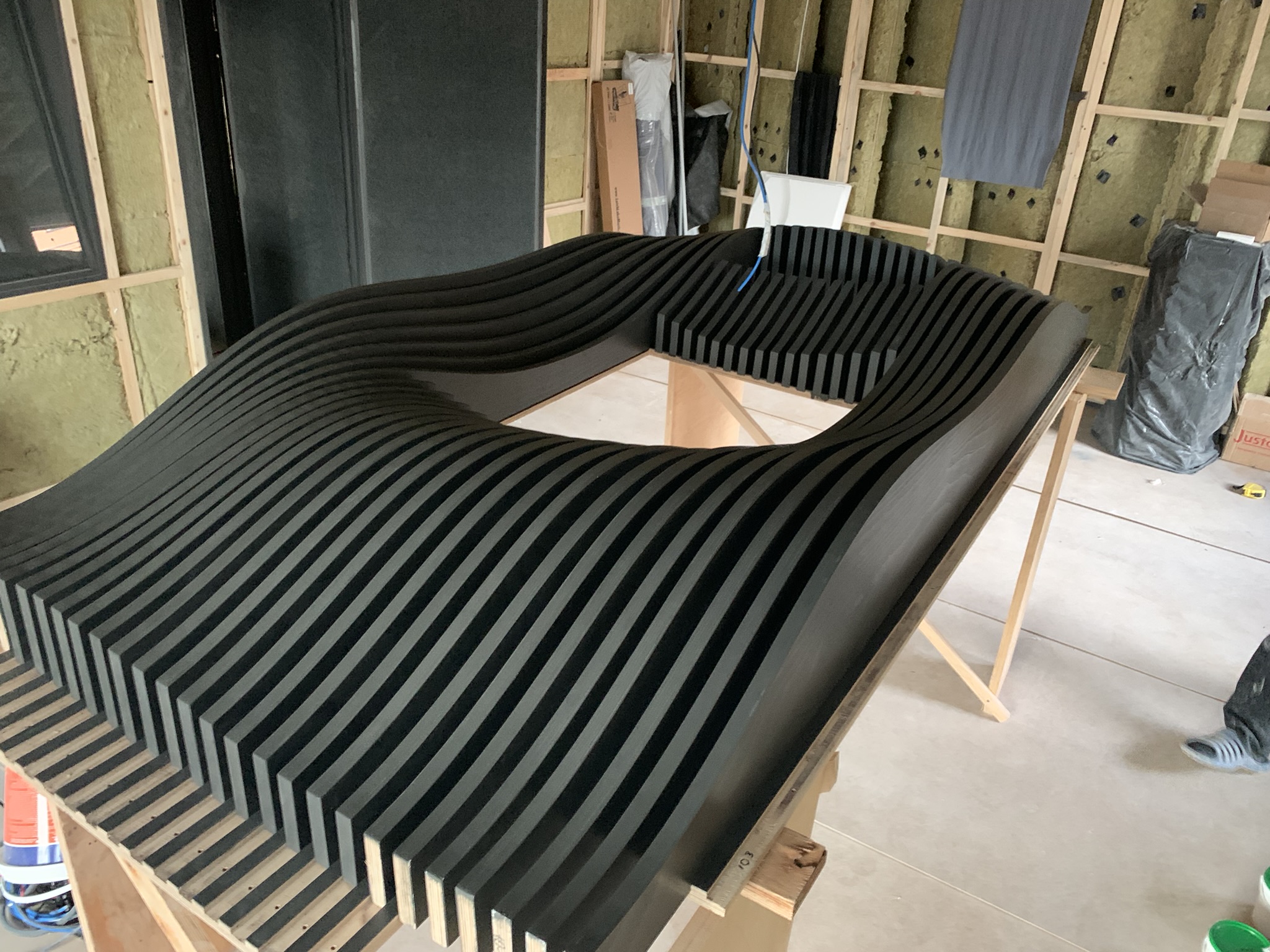
 The studio table is a different story. The availability of a CNC machine provoked the desire to make something unique, different, different. The wishes were as follows:
- impact on acoustics and monitoring conditions is minimal;
- material – natural solid ash (not chipboard or MDF) 40 and 20 mm thick;
- cables, power supplies (18 pcs.) and other switching are hidden;
- fasteners – be hidden;
- SSL controllers – must be located on a separate movable section of the tabletop, and when moving it should not touch the computer keyboard and the skin of the armrests;
- equipment must be ventilated, etc.
3-D modeling in Fusion 360 helped in solving these problems.
The table turned out to be comfortable, ergonomic, beautiful, although not cheap.
 Finally…
 The floor covering is made of wear-resistant vinyl.
Climate control – an autonomous ventilation system plus an almost silent Mitsubishi ducted air conditioner, controlled via Wi-Fi.
The video monitor is panoramic with a swivel mount to the studio table.
Video projector. The back wall is a retractable screen with PU.
Retractable system for the movable section of the tabletop – GRASS Movement Systems.
Studio microphone and keyboard stands are available upon request.
 And most importantly…
This work gave us all pleasure, and the monitoring, acoustic features of the studio and its design pleasantly surprised many of my colleagues, even from European countries.
What do you wish for the studio? The same as for all of us: victory and peace.
Glory to Ukraine! Слава Україні!
Popularity: 1% [?]


